'/%3e%3ccircle%20cx='520'%20cy='70'%20r='120'%20fill='%237c3aed'%20opacity='0.10'/%3e%3ccircle%20cx='110'%20cy='330'%20r='160'%20fill='%237c3aed'%20opacity='0.07'/%3e%3crect%20x='0'%20y='72'%20width='640'%20height='10'%20fill='%237c3aed'%20opacity='0.10'/%3e%3c/svg%3e)
B2B lead generation is often measured by numbers.
How many leads did you generate?
How many contacts are in the database?
How many people replied?
Those numbers can look good while producing very little actual sales.
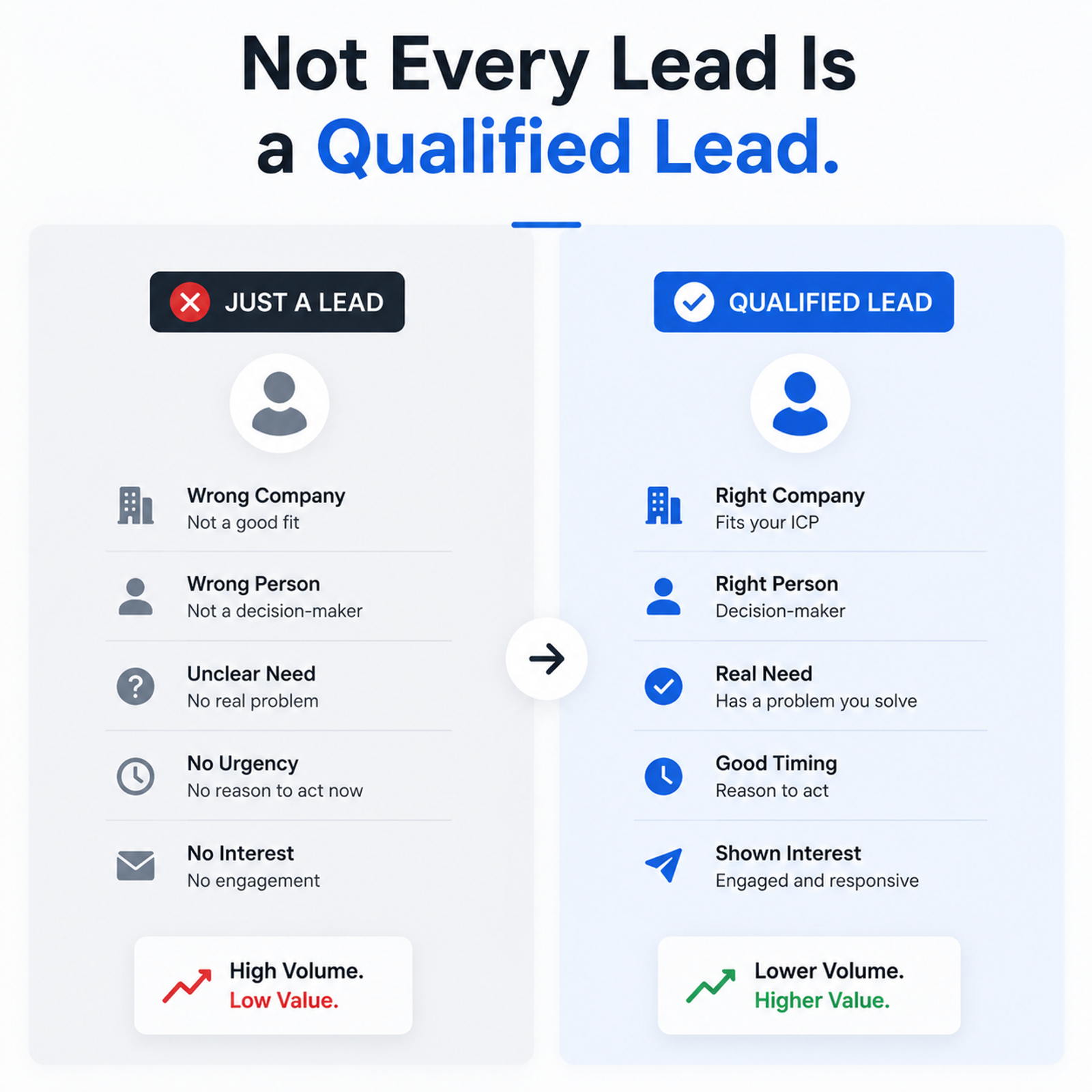
The problem is simple: not every lead is a qualified lead.
A person can match your industry, download something from your website, or reply to an email and still have no real reason to buy.
So what actually makes a B2B lead qualified?
1. The company is a good fit
Start with the business itself.
A qualified lead should match the type of company your product or service is built for.
Depending on your business, that could include:
- Industry
- Company size
- Location
- Revenue
- Business model
- Technology used
- Target market
For example, if you sell software designed for mid-sized SaaS companies, a two-person local business probably isn't a useful lead no matter how interested the person seems.
2. You're talking to the right person
A good company isn't enough.
You also need to reach someone who can influence or make the buying decision.
That might be:
- Founder
- CEO
- Sales leader
- Marketing leader
- Operations leader
- Procurement
- Another relevant decision-maker
The exact role depends on what you're selling.
Getting a positive reply from someone who has no connection to the buying decision may feel like progress, but it often isn't.
3. There is a real problem
Interest alone isn't enough.
A qualified lead should have a problem that your product or service can reasonably solve.
For example:
A company may say it is interested in sales outsourcing.
That tells you very little.
But if the company is actively trying to increase outbound sales, doesn't have an SDR team, and is already looking for an alternative, there is a much stronger reason for a sales conversation.
The difference is need.
4. Your solution is relevant
Even when a company has a problem, your offer needs to fit.
A lead can have a genuine sales problem but still not be a good prospect because:
- Your service doesn't solve that particular problem.
- Your pricing is far outside their budget.
- They are looking for something you don't provide.
- Their current situation makes your solution impractical.
Qualification is partly about deciding when not to pursue a lead.
5. There is some willingness to talk
A qualified lead doesn't necessarily need to be ready to buy today.
B2B purchases can take weeks or months.
But there should be some willingness to discuss the problem.
That might mean the prospect:
- Responded to outreach
- Asked a relevant question
- Requested more information
- Agreed to a call
- Confirmed a current business need
- Expressed interest in solving the problem
Without any meaningful signal of interest, calling the person a qualified lead can be misleading.
Lead vs qualified lead
This distinction matters.
A lead is simply a potential contact or company.
A qualified lead has passed whatever criteria your business uses to determine that the prospect is worth pursuing.
For example:
Lead:
“Company in the right industry.”
Qualified lead:
“Company in the right industry, right size, talking to the right decision-maker, has a relevant problem, and is open to discussing a solution.”
That's a very different level of value.
A qualified lead is still not a sales meeting
This is another distinction businesses often miss.
The sales process usually looks more like:
Lead → Qualified Lead → Sales Meeting → Opportunity → Customer
Each step answers a different question.
A lead asks:
Who could potentially buy?
Qualification asks:
Is this worth pursuing?
A meeting asks:
Will they actually have a sales conversation?
An opportunity asks:
Is there a realistic buying opportunity?
A customer asks:
Did they actually buy?
Treating all five as the same metric creates bad reporting.
Why lead volume can be misleading
Imagine two lead generation campaigns.
Campaign A
1,000 leads
20 qualified leads
5 meetings
Campaign B
200 leads
60 qualified leads
18 meetings
Campaign A looks better if you're only counting leads.
Campaign B is clearly more useful for a sales team.
This is why businesses should care about lead quality, not just lead volume.
How should a business define a qualified lead?
There is no universal definition.
Your qualification criteria should be based on your ideal customer and sales process.
A simple framework could include:
Fit — Does the company match your target customer?
Role — Are you talking to someone relevant to the buying decision?
Need — Does the business have a problem you can solve?
Interest — Is there a reason to have a conversation?
Timing — Is there a reasonable opportunity to act?
The more clearly you define these criteria, the easier it becomes to measure your lead generation performance.
Don't pay for leads just because they're called leads
This is especially important when buying lead generation services.
Ask what you are actually receiving.
Are you getting:
- Contact details?
- Companies matching your target profile?
- Interested prospects?
- Qualified leads?
- Booked meetings?
- Attended meetings?
Those are different deliverables and should not be treated as interchangeable.
A list of 1,000 contacts might sound impressive, but if none of them are a good fit, it has little value to your sales team.
The real goal of B2B lead generation
Good lead generation isn't about producing the biggest list.
It's about producing the right opportunities for the sales team to work on.
The closer your leads are to your ideal customer, the less time your sales team wastes chasing companies that were never likely to buy.
That's why the best lead generation process starts with qualification—not after the sales team receives the leads, but before they do.

-DLQfbe3o.png)
-11oh3t65.png)
-DwPTbEAW.png)
-BbH369h1.png)